IMCS Poster Presentation Download
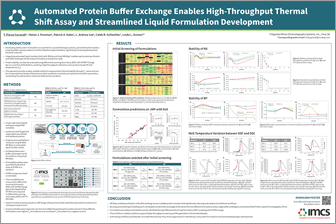
Poster #577: Automated protein buffer exchange enables high-throughput thermal shift assay and streamlined liquid formulation development
For more related content please see our Resources Page.

Poster #577: Automated protein buffer exchange enables high-throughput thermal shift assay and streamlined liquid formulation development
Automated protein buffer exchange enables high-throughput thermal shift assay and streamlined liquid formulation development
T. Pierce Carrouth1, Patrick A. Kates1, Linda Grimes1, Nolan Foreman1, L. Andrew Lee1
1Integrated Micro-Chromatography Systems, Inc.
Refining optimal storage solutions for purified proteins is essential for biological products ranging from enzymes, antibodies and other biological reagents. Multiple factors, such as pH, buffer type, additives and their concentrations, can impact the protein stabilities. Dialysis into various buffers of interest requires manual intervention and multiple solvent exchange times. Automation of ultrafiltration or size exclusion would be preferred but typically reliant on centrifugation or positive pressure manifolds in plate format. Post buffer exchange is also challenging with protein concentration normalization and high throughput analysis. Thus, there exists a consensus in the community for a need to rapidly evaluate a robust combination of formulation conditions coupled with appropriate analytical throughput to screen for optimal storage recipes.
In this work we addressed both challenges using an automated workflow on the Hamilton Microlab STAR for three different proteins. IMCStips® containing immobilized metal ion affinity chromatography (IMAC) resin enabled rapid purification of polyhistidine tagged proteins. These proteins were then simultaneously buffer exchanged into different formulations using IMCStips® SizeX100 tips. Next, a thermal shift assay using SYPRO© Orange dye and a real-time polymerase chain reaction (PCR) instrument were used to measure melting temperatures. Furthermore, this automated workflow was paired with mathematical analysis using design of experiments (DOE) sample sets allowing for the discovery and application of higher-level interactions between formulation components. The result was a proof of concept application for efficient and cost-effective way to filter and screen 96 formulations for a single protein at once and has led to 3 proteins demonstrating improved stability in on-going LTS studies.
For more related content please see our Resources Page.
"*" indicates required fields

"*" indicates required fields

